
This article will show you how to-do lists make you more productive, and help you write a kickass to-do list.
Today was grueling, every hour crammed with e-mails, meetings, and a million other fires. Even breathing felt hard, as if one of the big trees outside the office was planted on your chest instead of in the ground. Yet, when sundown came, as it almost always will, those important things you should have done were almost untouched. ?I want my day back?, you think, but time does not work this way. What a dread. This is how a day is wasted, insignificant moment by insignificant moment.
© <a href='https://www.123rf.com/profile_rawpixel'>rawpixel</a>, <a href='https://www.123rf.com/free-images/'>123RF Free Images</a>
Being Scattered is Normal
There is actually nothing wrong with you. Being overwhelmed by a big workload and not making progress is not a mental defect. It is in fact the most natural way of being. Most of us are not blessed with a naturally organized mind, which is why we need a system to help keep our attention on the tasks that are truly important. Without a focusing strategy, our brain power simply disperses between all competing demands. Just as an egg is kept whole by its lean but mighty shell, human brains need a shield of sorts to keep our attention from spreading too thin.
If you have tried using a to-do list before, but never stuck with it, don?t blame yourself. First, building a new habit can feel harder than winning gold at the Olympics. And then, as if getting started and staying enthused wasn?t difficult enough, there is no shortage of ?internet gurus? giving you all the reasons why to-do lists don't work. Talk about motivating right?
The problem? Simple, they have it all wrong. Every efficient person I know writes down their intentions, gets the work done, and then crosses the tasks off the list as they are completed. In fact, this last step is more gratifying than iced water on a long hike, and it?s one of the reasons this process works.
How To-Do Lists Help you
To-Do lists help you be more productive in 3 main ways.
- Help you prioritize: Let you to focus attention only on the most important tasks.
- Reduce mental fog: They also lower your stress by relying on a consistent process, regardless of how overwhelming the workload feels, or the number of distractions competing for your attention.
- Habit-forming: Using a to-do list is simple, and you are rewarded at the end (with less anxiety, a completed task and the pleasure of crossing it off the list). This encourages you to rely on the process over and over, thereby creating a great new habit that can stay with you for the rest of your life.
Help you Prioritize
A to-do list narrows your focus to the tasks that need to get done today. Your tasks can be separated into two types. Tasks are either important, or they are urgent.
Urgent Vs Important Tasks
Failing to get your expense report completed by the due date may result in negative consequences. This is urgent if today is the cutoff date. But finishing this task will not improve the company?s profitability or get you promoted. It may be urgent, but it?s not important.
In contrast, let?s say you are working on a project that will reduce the company?s operating costs by 25% over the next 5 years. This task may not feel the least bit urgent, even though it will result in market share growth for your company, and recognition for you personally. This is an important task.
Of course, your boss could also signal the operating costs project has to be delivered by end-of-week, because the financial quarter ends in two days, and your recommendations will help the company avoid going out of business (and you losing your job). Congratulations, you are now the proud owner of a task that is simultaneously urgent and important (hint, those always come first).
To-do lists should first include tasks that are important, urgent, and obviously those tasks that share elements of both urgency and importance. When deciding which tasks to prioritize, you should avoid prioritizing only the fires (the urgent tasks). Sometimes you cannot avoid dealing with the short-term 911, but on most days, it?s critical to devote sufficient time to the assignments that add long-term value. Otherwise, you will find yourself running hard and fast, but not getting much of importance accomplished.
Reduce Mental Fog
When we are trying to move quickly between priorities, sometimes our time begins to blend into a kind of murkiness that engulfs everything we touch. Like the upside down in Stranger Things, there?s a haze that never leaves you, as if your attention is spread throughout millions of tiny snowflakes that are flowing all around you. I call this feeling ?the funk?. More serious people call it mental fog.
The funk starts with a feeling of heaviness in your eyes, same as when you are way past your bedtime. It?s followed by low energy and anxiety, with basically half your brain refusing to focus on anything important while the other half feels guilty about it.
Brain fog can be the result of more than one condition. It?s almost inevitable if you lack adequate sleep, exercise, and nutrition. If you had a hard-partying weekend, don?t be surprised if Monday does not feel so hot. On the other hand, mental fog can and often shows up when you are well rested. So how do you crawl out of the funk pit after you?ve fallen in? The obvious answer is to exercise, eat right, get adequate sleep, avoid drugs and alcohol, and get regular check-ups with your doctor. While these easy controllables are important, they are not the focus of our article. Goes without saying, if you are partying like a rock star, and eating like shit, stop doing that.
Unfinished tasks can cause brain fog
Unfortunately, even when you are taking care of yourself, brain fog shows up. It tends to happen when you are most overwhelmed by one or more important projects and tight deadlines (in other words, when you can least afford to feel this way). Why? Some studies suggest that unfinished tasks are a big part of the equation. As you move from one open project to the next, there is a residue of attention that remains with the initial task. Your conscious mind may have moved on, but your entire brain hasn?t gotten the message. Most of us are not wired to easily scan our many demands, compare them quickly to the time available, and optimize our steps to get everything done on time. Computers can do that, humans not so much. Most of us can also not jump from task to task, without leaving a little part of your focus with each one you put move away from.
Having a plan helps
While many tasks without any strategy for completing them may inhibit our ability to focus on any of the tasks, research also suggests that creating specific plans for each task helps to lower stress and improve attention. It?s as if your brain feels better and lets you move your attention move fully when it knows you?ve got your act together.
My personal experience seems to validate these findings. Time after time, I can vanish brain fog, reduce anxiety, and increase focus by merely writing down everything I have to do, re-writing it in order of priority, and then getting to work done one task at a time. As the work gets finished, I cross each item off the list (while relishing in delight).
These small wins throughout the day make me feel accomplished, keep me grounded, and provide a diary of completed tasks that are easily referenced in the future (such as during review time or a job interview). It also reminds me that I can only work on one thing at a time. It allows me to forgive myself and to keep my expectations at a realistic level.
You cannot think your way out of brain fog
Look, when you are stressed out by a lot to do, you are not going to think or will your way out of it. You can however take rational steps to reframe the work and break it down into clear and manageable pieces. Writing down your priorities in a to-do list that is concise and clear, and then knocking down the tasks one at a time is the simplest, most effective way of getting yourself back on track.
Habit-Forming
We?ve already covered how using a to-do list helps you prioritize, helping you focus your attention, and reducing brain-fog in the process. But it?s this last part (connection to a habit-loop) that makes the entire process not just repeatable, but likely to be repeated. In other words, to-do lists are not just something you could use sometimes, but a habit you should rely on every single day.
Allow me a brief detour to rave about ?Atomic Habits? written by James Clear, a book that made a big positive difference in my life. As a reminder, I only recommend books here that I have actually read and that added value to my life. In Atomic Habits, Clear teaches you how to create good habits and break bad ones though 4 simple phases: Cue, Craving, Response, Reward.
Cue
The cue triggers your brain to do something specific, reminding you that a reward may be possible if an action is taken. This is not unique to habit formation. Your brain is constantly looking for potential rewards. It?s how we function. At every moment, we are thinking ?What do I want to do next with my time? What will make me happy? What will help me avoid not being happy??
For example, we may see a piece of cake and think ?Oh, I bet that cake will taste great, let me eat it?. The cake itself represents the cue. A cue can also be a thought or a feeling, it need not be physical, or sweet and delicious.
The cue for using a to-do list can be the realization that you have multiple tasks to complete and are feeling overwhelmed by the high workload. Those of us who have used to-do lists for years may also be triggered by rituals such as starting our workday. In this case, our cue is more routine, a recurring habit in itself. We?ll cover the importance of rituals on future articles, so stay tuned.
Cravings
The second step of the habit loop is the craving. A craving is the motivation that pushes you to continue on the initial action you took. In most cases the action will require work, but the craving focuses you on the reward. Without this reward, there is no reason to act. It?s this desire to change that triggers your action. For example, you may not look forward to driving ½ an hour to visit your girlfriend, but you are motivated by the anticipation (the craving) of spending time with her.
Or you may not be motivated to take a shower for its own sake, but by the anticipation of feeling clean. Cues and Cravings go hand-in-hand. A cue is not a cue until you interpret it and leads to a desire for a specific reward.
Let?s apply this logic to task management. The more you use to-do lists, the more you?ll crave the feelings of reduced anxiety and control that you?ll come to expect. When you are overwhelmed, you can still crave the feeling of control that comes from knowing exactly what you will do, and in what order of priority. Over time, as you repeat these steps, a habit loop is formed.
Response
The third step is the response itself. The thing you do to satisfy the craving in anticipation of the reward. Eating the cake, getting in the car to go see your girlfriend, or taking the shower, are both examples of responses. A response is all about action, it?s the ?doing? part of this equation.
A response in this case is the act of brainstorming about everything you have to do, writing it down in some order of priority, and focusing your attention on finishing one task at a time. You may have 11 things to get done today, but only time to do 4, which makes you feel overwhelmed and foggy. But if you have a solid process that you rely on, then you will at least know exactly what can be done and what cannot.
Over time, as you repeat these steps, you will begin to crave the reduction in anxiety and satisfaction of finishing your task and crossing it off the list. Trust me, a to-do list will become a foundational instrument for managing your time.
Reward
Finally, your response is rewarded by whatever you?ve been craving all along. From cue, to craving, to action, all the steps lead to this final prize. By engaging in this process, two things are happening:
- Your brain is being compensated for noticing specific cues, nurturing the cravings those cues generate, and taking concrete actions to satisfy the cravings.
- You are also learning about what actions to take and not to take in the future, based on the effort you invested, and the reward that was returned. If showering makes you feel as clean as you imagined, you will want to shower again tomorrow. If you are disappointed by your girlfriend?s attitude after you drove across town to see her, perhaps you skip visiting next week. But it?s this last part, how it fits into the habit loop, that makes the entire process likely to be relied upon in the future over and over again.
Below is an example of how to-do lists help fit into the habit loop, all the way to the reward part.
- Cue: It?s Monday, you have multiple projects and deliverables by Friday, which makes you feel stress and anxiety.
- Craving: You desire to not feel overwhelmed. You want the work to be completed on time. You want to feel in control while completing the tasks. You recall from prior experiences, that writing your tasks down in order of priority and focusing on one task at a time, helps you decrease anxiety and get your work done. You also recall how good it feels to cross the task off your list when they are finished.
- Response: You start a to-do list, prioritizing tasks in order of importance and urgency. Then you focus on completing one task at a time.
- Reward: As engage in this process, you feel better, which improves clarity, reduces anxiety, and puts you back in control. While you are taking these steps, you appreciate the connection between the process of using the list and your positive feelings, which raise the likelihood you?ll use it again in the future. When you are done, you cross the task off the list, giving you a nice enjoyable hit of endorphin (feels great).
Habit Loop (To-Do List)
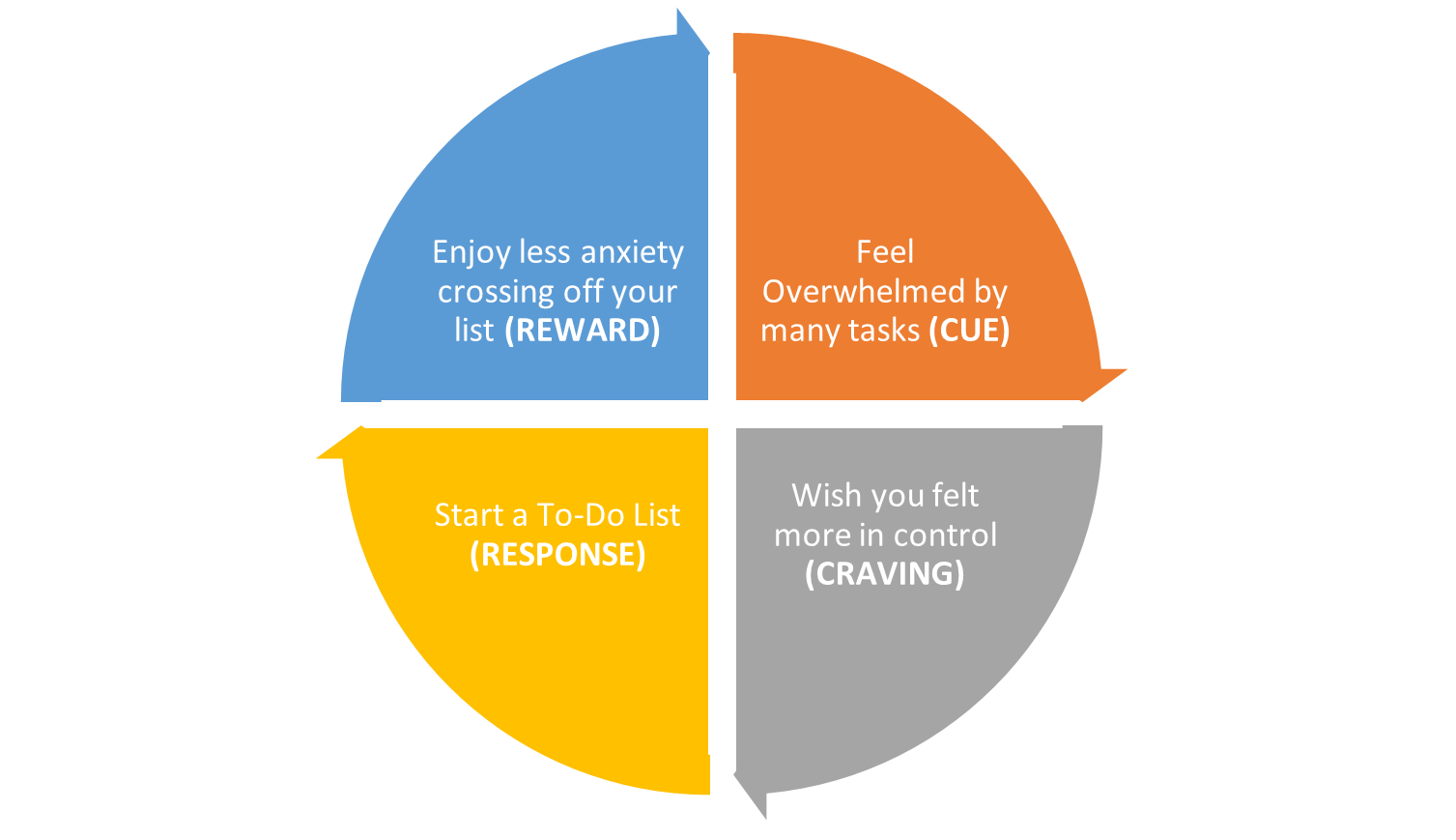
This is a never-ending loop? congratulations you have just created a new habit that will stay with you for the rest of your life.
How to write a kickass to-do list
Before you get started with a to-do list, there are three other elements you have to keep in mind.
1. Open Items List: Write down everything that you need to get done. This is not your to-do list, so it does not need to be prioritized. Just list it as it comes to your mind.
2. Time available: Confirm how much time you have to get your tasks completed. For example, your workday minus mandatory meetings, etc.?
3. Calculate task length: Estimate how much time it?ll take you to complete each task. Don?t overthink it, just write the time next to your tasks on the open items list (Finish Expense, 15 minutes; Write Project Summary, 2 hours; etc.?).
Steps for creating a To-Do List
Ok let?s get your to-do list, and this post wrapped up.
- Write an Open Items List.
- Calculate how much time each task will take.
- Confirm how much time you have to complete your tasks today.
- Create a short to-do list (in most cases no longer than 5 items), prioritize most important tasks. If you must include an urgent task, that?s ok. But ensure you are making time for important tasks that drive real long-term value.
- Focus on completing one task at a time starting with # 1 (which should coincide with the task with the highest priority).
- Cross off the task when you complete it. Example:
?Write Project Summary?. - Take a deep breath and give yourself credit for completing the task. Enjoy the moment.
- Move on to the next task and keep going. You totally got this!
Brief Closing Thought
To-do listing is a simple and yet powerful idea that has made a world of difference in my life. If you want to begin or continue on your journey of empowerment, you?ll need to add good habits and eliminate or at least reduce the bad ones. There?s just no other way to create a more productive and meaningful life, at least no other way that I know. You can change your life for the better one good habit at a time. That?s the way I?ve changed mine. Hope you found this post helpful. Best of luck in all you do.